Export-Oriented-Aquaculture-2021-22 to 2025-26
L. vannamei
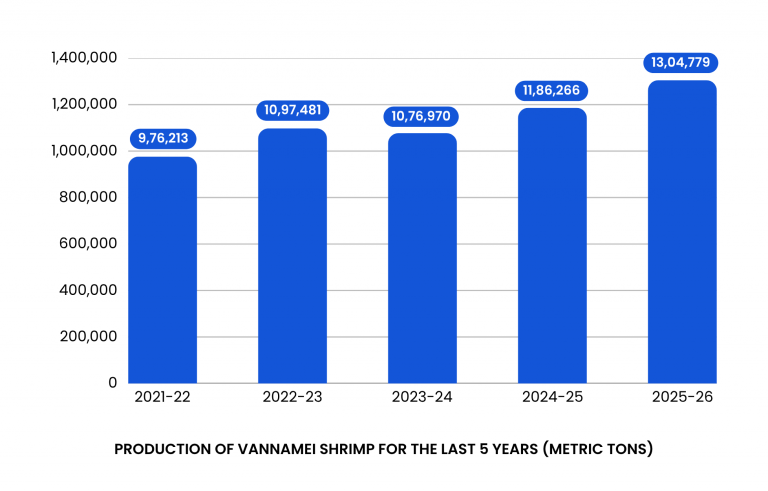
LAST 5 years L. vannamei production (Values in Metric Tons)

Analysis:  The production of Pacific whiteleg shrimp (Litopenaeus vannamei) has shown a steady upward trend over the last five years, increasing from 976,213 MT in 2021–22 to 1,304,779 MT in 2025–26, reflecting an overall growth of 33.66% during the period. Production witnessed a substantial increase of 12.42% in 2022–23, reaching 1,097,481 MT, driven by expanded farming activity and improved productivity. A slight decline of 1.87% was observed in 2023–24, when production fell marginally to 1,076,970 MT. However, the sector demonstrated strong resilience, rebounding in 2024–25 with a production of 1,186,266 MT, representing a growth of 10.15% over the previous year. This positive momentum continued in 2025–26, with production reaching an all-time high of 1,304,779 MT, registering a further growth of 9.99%. Overall, the data indicate sustained expansion of the vannamei shrimp farming, with an average annual growth rate of approximately 7.5%, highlighting its continued importance as the backbone of India’s aquaculture and shrimp export industry.

P. monodon production
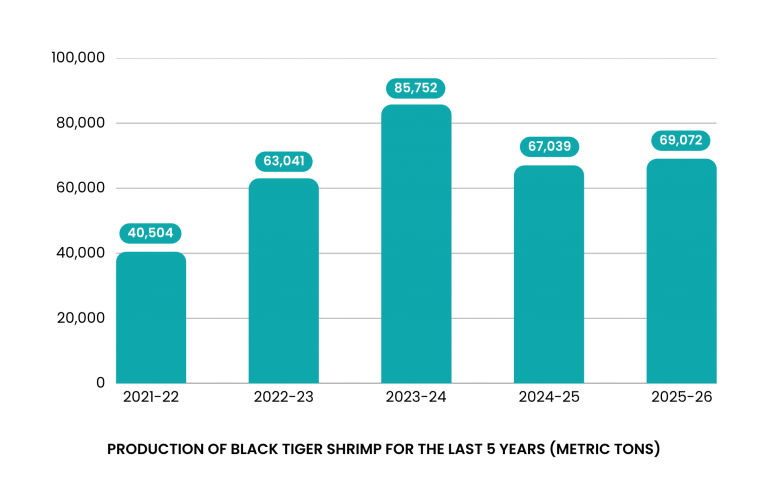
Last 5 years P. monodon production (Values in Metric Tons)

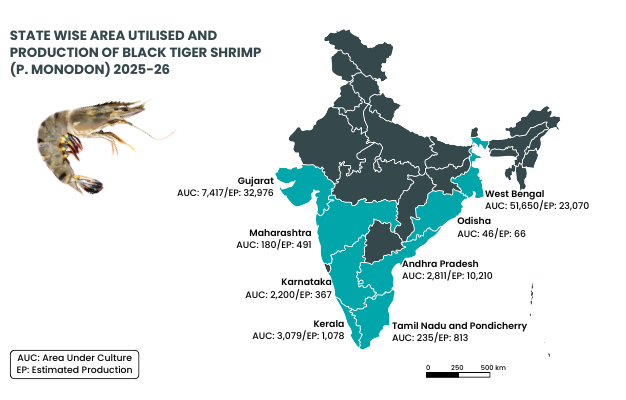
Analysis:  The production of Black Tiger Shrimp (Penaeus monodon) exhibited a fluctuating trend over the last five years, increasing from 40,504 MT in 2021–22 to 69,072 MT in 2025–26, representing an overall growth of 70.5% during the period. Production recorded a strong increase in 2022–23, rising by 55.6% to 63,041 MT, followed by a further growth of 36.0% in 2023–24, when production reached a peak of 85,752 MT. However, production declined significantly by 21.8% in 2024–25 to 67,039 MT, indicating possible challenge related to market demands. In 2025–26, the sector showed signs of recovery, with production increasing modestly by 3% to 69,072 MT. Despite the fluctuations observed in the latter years, the overall trend remains positive, reflecting a growing interest in Black Tiger shrimp culture and its continued importance as a high-value shrimp species in India’s aquaculture sector.

Scampi production
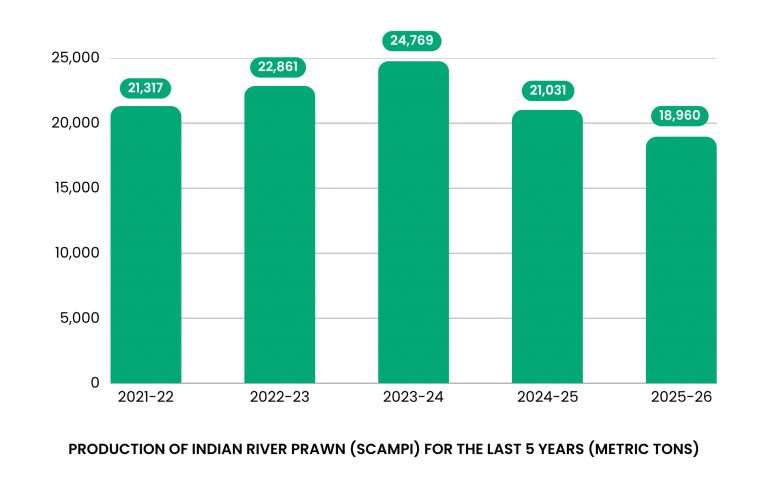
Last 5 years Scampi production (Values in Metric Tons)

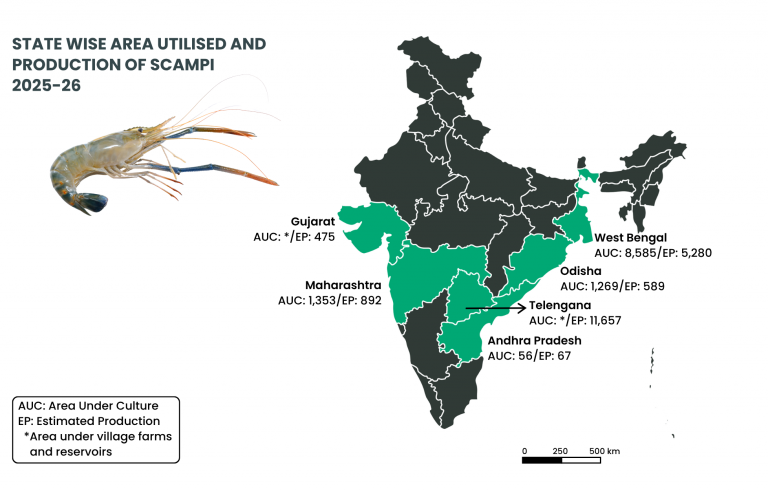
Analysis:  The production of Indian River Prawn or Scampi (Macrobrachium rosenbergii) displayed a mixed trend over the last five years, with production increasing from 21,317 MT in 2021–22 to 18,960 MT in 2025–26, after experiencing both growth and decline during the period. Production rose steadily from 21,317 MT in 2021–22 to 22,861 MT in 2022–23, registering a growth of 7.2%, and further increased to a peak of 24,769 MT in 2023–24, reflecting an annual growth of 8.3%. However, this upward trend was reversed in the subsequent years, with production declining sharply by 15.1% to 21,031 MT in 2024–25 and further decreasing by 9.8% to 18,960 MT in 2025–26. Overall, Scampi production recorded a net decline of 11.1% over the five-year period. The data suggest that while the sector experienced encouraging growth up to 2023–24, sustaining production levels has become challenging in recent years, possibly due to factors such as long culture duration, competition from marine shrimp farming, seed availability constraints, or changing market dynamics.

Export-Oriented-Fishes
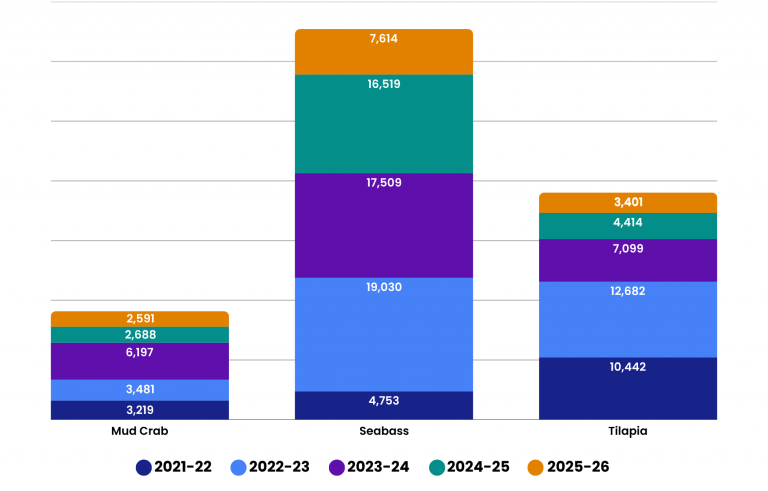
Last 5 years production of Export oriented fishes (Values in Metric Tons)

Analysis: The production of diversified aquaculture species has shown varying trends over the last five years, reflecting both domestic and international market preferences, culture practices etc. Among the species, Seabass emerged as the most significant contributor, recording a substantial increase from 4,753 MT in 2021–22 to a peak of 19,030 MT in 2022–23, followed by a gradual decline to 17,509 MT in 2023–24, 16,519 MT in 2024–25, and 7,614 MT in 2025–26. Tilapia (Genetically Improved Farmed Tilapia) production demonstrated strong growth during the initial years, increasing from 10,442 MT in 2021–22 to 12,682 MT in 2022–23, and reaching a peak of 7,099 MT in 2023–24 within the reported trend, before declining to 4,414 MT in 2024–25 and 3,401 MT in 2025–26.

Mud Crab production remained relatively stable, rising from 3,219 MT in 2021–22 to 6,197 MT in 2023–24, before moderating to 2,688 MT in 2024–25 and 2,591 MT in 2025–26. Overall, the data indicate that diversified aquaculture species, particularly Seabass and Tilapia, have gained prominence as alternative culture species, although production levels have fluctuated in recent years, highlighting the need for sustained technological support, quality seed supply, and market development to enhance diversification in the aquaculture sector.

L. vannamei
Production-of-monodon-shrimp
Scampi