
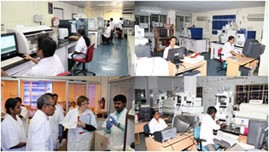
 National Residue Control Plan (NRCP) is a statutory requirement for export to EU countries. Under NRCP, definite sampling schedule and sampling strategies are drawn every year for monitoring the residues of substances like Antibacterial/Veterinary Medicinal Products and environmental contaminants. Samples are collected from hatcheries, feed mills, aquaculture farms and located in maritime states and tested for the presence of any residue/contaminant of the following substances:
Group A – substances:
| Substance group | Substances | Substance monitored |
| A1c | Steroids | Progesterone |
| MedroxyProgestrone (acetate) | ||
| 17-β Oestradiol | ||
| 17-alpha-methyl Testosterone | ||
| A2a | Prohibited substances listed in Table 2 of the Annex to Regulation (EU) No 37/2010 –Chloramphenicol |
Chloramphenicol |
| A2b | Prohibited substances listed in Table 2 of the Annex to Regulation (EU) No 37/2010 – Nitrofurans | Nitrofuran Metabolites (AOZ, AMOZ, SEM, AHD & DNSH) |
| Nitrofurans (parent compounds, in case of feed samples) | ||
| A2c | Prohibited substances listed in Table 2 of the Annex to Regulation (EU) No 37/2010- –Nitroimidazoles |
Nitroimidazoles (Metronidazole, Dimetridazole & Ronidazole , Ipronidazole and their hydroxyl compounds ) |
| A2d | Pharmacologically active substances, not listed in Table 1 of the Annex to Regulation (EU) No 37/2010– other A2 substance | Dapsone |
| Dyes | Dapsone Malachite Green and Leucomalachite Green | |
| Crystal Violet and Leucocrystal Violet | ||
| A3b | Protection products & biocides | 2,5-dichlorobenzoic acid methyl ester (sum of 2,5-dichlorobenzoic acid and its ester) |
| A3c | Other unathuorised antimicrobials | Norfloxacin |
| Nalidixic acid |
Group B substances/residues:
| Substance group. | Substances | Substance monitored |
| B1a | Antimicrobials | |
| 1.Quinolones /Fluoro-quinolones | Oxolinic acid | |
| Difloxacin | ||
| Sarafloxacin | ||
| Enrofloxacin(sum of Enrofloxacin & Ciprofloxacin) | ||
| Danofloxacin | ||
| Flumequine | ||
| 2. Tetracyclines | Tetracycline & its 4-epimer | |
| Oxytetracyline & its 4-epimer | ||
| Chlortetracycline & its 4-epimer | ||
| 3.Sulfonamides | Sulfadiazine, Sulfamethoxazole, Sulfamethoxypyridine, Sulfamethizole, Sulfamethazine, Sulfamerazine, Sulfapyridine, Sulfadimethoxine, Sulfachloropyradizine, Sulfathiazole, Sulfadoxine | |
| 4.Macrolides | Erythromycin A | |
| Tilmicosin | ||
| Tylosin | ||
| 5.Beta Lactams | Lincomycin | |
| Ampicillin | ||
| Benzyl Penicillin | ||
| Dicloxacillin | ||
| Oxacillin | ||
| Cloxacilin | ||
| Amoxicillin | ||
| 6.Polypeptides | Colistin A & B | |
| 7.Diaminopyramidines | Trimethoprim | |
| 8.Aminoglycosides | Neomycin B | |
| Spectinomycin | ||
| B1a | Anthelmintics | Emamectin |
| Ivermectin | ||
Pesticides:
| Substance group | Substances | Substance monitored |
| Pesticides | Organochlorine compounds | α BHC, β BHC, γ BHC, Aldrin, 2,4 DDT, 4,4 DDT, 2,4 DDE, 4,4 DDE, 2,4 DDD, 4,4 DDD, Heptachlor, Heptachlor Epoxide, Dieldrin, Endrin, HCB, Cis-Chlordane, Trans-Chlordane and Oxy-Chlordane |
Contaminants:
| Substance group | Substances | Substance monitored |
| Halogenated persistent organic pollutants | Poly Chloro Biphenyls | PCBs ( PCB 28, PCB 52, PCB 101, PCB 138, PCB 153, PCB 180 ) |
| Dioxins/Furans and dioxin like PCBs | ||
| Metals | Chemical Elements | Mercury, Cadmium, Arsenic and Lead |
Following are the other residue monitoring/control programmes undertaken by MPEDA QC Laboratories:
- Monitoring of Pesticide Residues at National Level (MPRNL):- This is an ongoing project funded by Dept. of Agriculture (MoA). The samples of inland fishes, crustaceans, and Molluscans collected from all the maritime states are analyzed for organo-chlorine pesticide residues by MPEDA QC Laboratory in Kochi.
- Monitoring of radio nuclides:- The wild-caught Fishes, Shrimps and Cephalopods samples are collected from different regions and forwarded to BARC, Mumbai, for the analysis of radio nuclides.