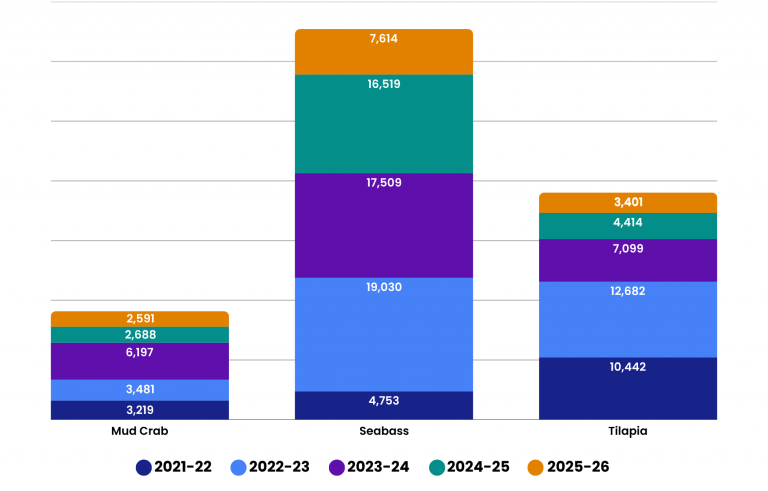
Analysis: The production of diversified aquaculture species has shown varying trends over the last five years, reflecting both domestic and international market preferences, culture practices etc. Among the species, Seabass emerged as the most significant contributor, recording a substantial increase from 4,753 MT in 2021–22 to a peak of 19,030 MT in 2022–23, followed by a gradual decline to 17,509 MT in 2023–24, 16,519 MT in 2024–25, and 7,614 MT in 2025–26. Tilapia (Genetically Improved Farmed Tilapia) production demonstrated strong growth during the initial years, increasing from 10,442 MT in 2021–22 to 12,682 MT in 2022–23, and reaching a peak of 7,099 MT in 2023–24 within the reported trend, before declining to 4,414 MT in 2024–25 and 3,401 MT in 2025–26.
Mud Crab production remained relatively stable, rising from 3,219 MT in 2021–22 to 6,197 MT in 2023–24, before moderating to 2,688 MT in 2024–25 and 2,591 MT in 2025–26. Overall, the data indicate that diversified aquaculture species, particularly Seabass and Tilapia, have gained prominence as alternative culture species, although production levels have fluctuated in recent years, highlighting the need for sustained technological support, quality seed supply, and market development to enhance diversification in the aquaculture sector.